Written by Kiara Corales
–
Fragments of Joy at The Pound Arts Centre marked a significant milestone for artist Betty Sargent: her first solo exhibition, bringing together work produced over the past decade. While Betty has featured in numerous group exhibitions — including Boats, Bedminster, Biscuits and Butchers (2025) and Here Today, Here Tomorrow (2024) — this presentation brings her distinct visual language fully into view, celebrating her achievements and setting the stage for what comes next.
Stepping through a doorway adorned with large, shaggy pompoms, we entered a world of crochet and intricate textile collages. Betty’s work is both soft and bold, animating the brick-lined walls with traces of her joy, stitched into threads that are cut, twisted and woven by hand. At first the works appeared playful and whimsical; up close, their carefully considered sense of scale, composition, texture and colour revealed an artist who has steadily cultivated confidence and fluency in her practice.
I have known about Betty’s talents in crochet for several years, having encountered her deftly crafted crocheted replicas of figurines, gathered overtime from second-hand shops, such as in Figurines – collected and crocheted (2019-ongoing). She has spoken of enjoying these objects so deeply that she felt compelled to remake them, transforming the ordinary and overlooked into forms shaped by memory and care. A similar tenderness animates her crocheted miniatures of family and friends in People I Know (2018-ongoing), where gestures, postures and sartorial quirks are rendered stitch by stitch.
Three flamboyant, show-stopping gownswere also on display: Ribbon Dress(2026), made entirely of crocheted ribbon; Untitled – Wool Dress (2025), made with thick, fluffy yarn; and The Dress (2016), inspired by a portrait of Queen Elizabeth I at the Red Lodge. Nearby stood a crocheted miniature church organ with a concealed music box breathing sound into the sculpture. The labour embedded in each work becomes especially apparent when we learn that Betty is entirely self-taught and does not read crochet patterns. She shares: “I just guess really in a way. I’d start from the bottom [of the dress] and then as I get up to the waist I take stitches off each side. Then it gets thinner at the top. I don’t know where I get the idea from. I just do it.” It is through instinct and tireless curiosity that she constructs her dresses and miniatures, conjuring worlds where craft and imagination know no restraint.
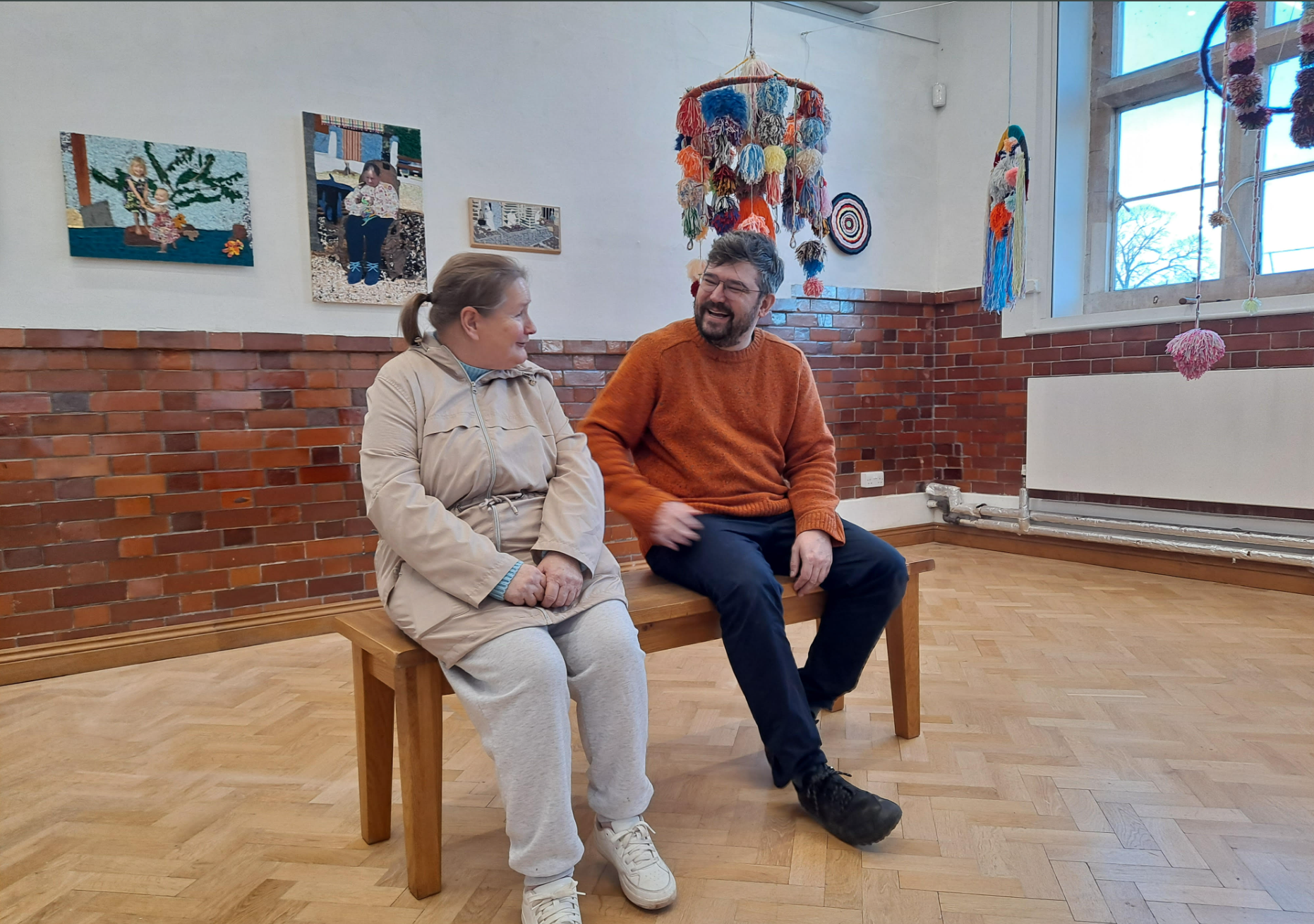
Materiality sits at the heart of Betty’s practice, evident not only in her crocheted forms but also across her wall-based textile and paper collages. These works mark a more recent turn in her experimentation with yarn and scraps gathered from studio corners and her home, where colour and texture guide each decision. Speaking about her use of found imagery such as in Children Gathering Fruit (2020), she recalls: “I used to work at a school near The Downs. I loved working with the children every day. Perhaps it’s why I’m drawn to this image [The Stewart Children (1773 – 1774), by Charles Willson Peale] that I saw while visiting a museum [Museo Nacional Thyssen Bornemisza in Madrid] with Colin.” Elsewhere, she explored memories of labour and making, such as her time spent in an old chocolate factory in Bristol and a weaver’s mill spinning yarn in The Chocolate Factory (2020) and The Spinner (2018).
At other moments, her work turns inward. In Grandmother with granddaughter (2019), a grandmother and a young girl appear across three interconnected scenes, quietly addressing intergenerational relationships, aging and childhood. Though these narratives are not always disclosed — Betty delights in concealment as much as revelation — her compositions carry stories that resonate universally.
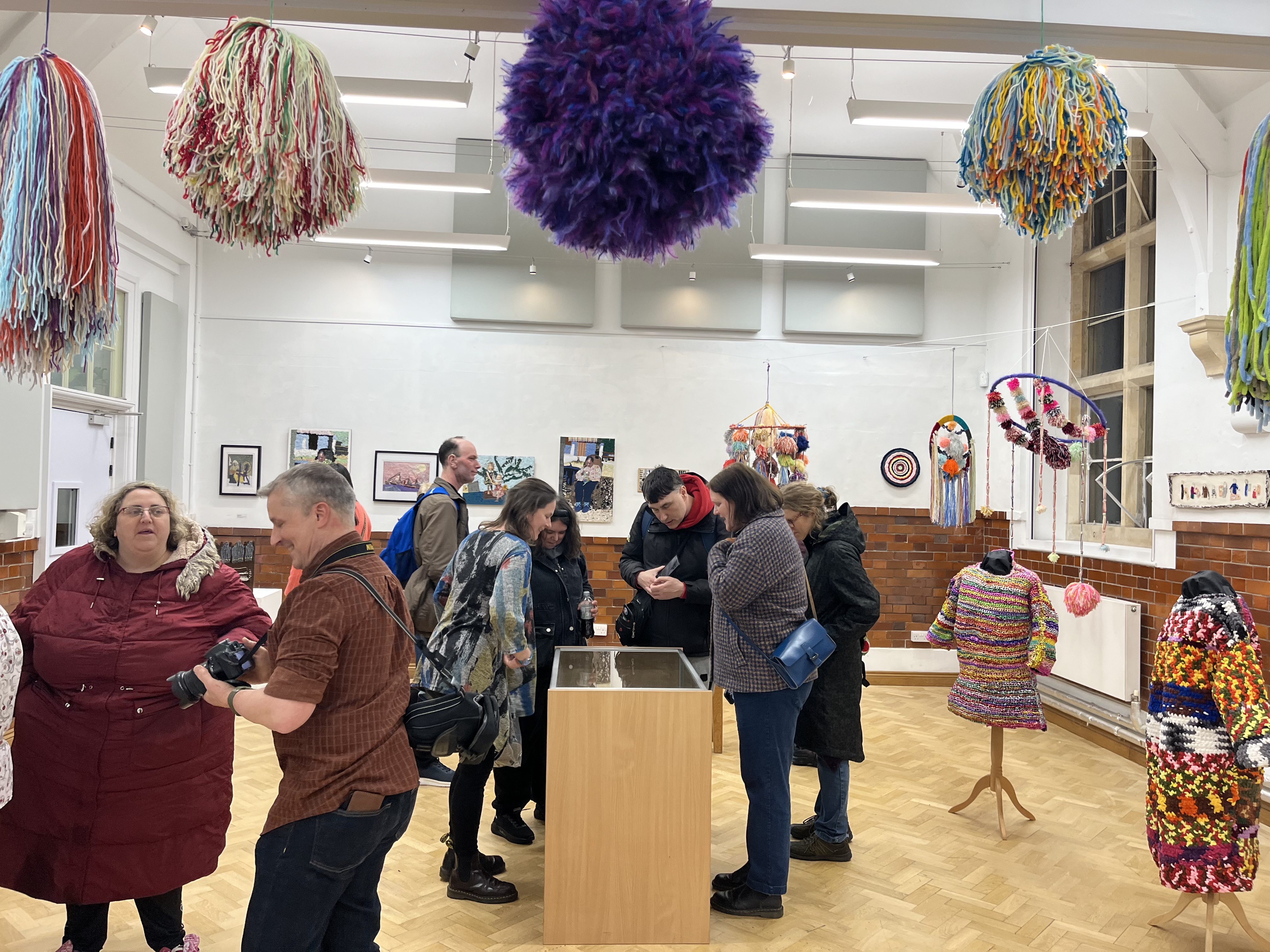
Betty’s making process is wholly intuitive yet far from impulsive. Over time, instinct has developed into a confident interrogation of form and composition. On her collages, she explains: “I cut up coloured yarn into tiny little bits and it goes really soft to feel. I think I know when it looks right. If I don’t like it, I take it off and put some other stuff on I like, like chocolate wrapping. If it looks fine, I leave it.” This discernment, of knowing when something works and when it does not, signals a growing clarity in her visual judgement — a self-assured artistic voice nurtured through the support of artist facilitators and peers at Art In Motion (AIM), a Bristol-based not-for profit organisation that collaborates with learning-disabled and neurodivergent artists.
It felt special that her first solo took place at The Pound Arts Centre; a space alive with community where artists are offered both visibility and belonging within a vibrant, multi-form cultural ecology. Especially as her journey as an artist is entwined with the opportunities that have shaped her. Supported by AIM’s ethos of collaboration, care and the familial connections they build within their groups, Betty’s work has flourished beyond the constraints of “outsider art”, reflecting a broader shift that recognises learning-disabled artists as central voices within contemporary art. Her practice has resonances with artists such as Phyllida Barlow and Nnenna Kalu, whose work similarly privileges intuitive, embodied making. The rise of supported studio practices, alongside recognition such as Kalu’s Turner Prize win, forms an important backdrop to Betty’s exhibition.“Working with AIM has made a really big difference to my life. It’s really good coming along and doing work in the studios – it’s a great opportunity. I like everything about being involved, but particularly doing my artwork and knowing there are people around me to help if I need it”.
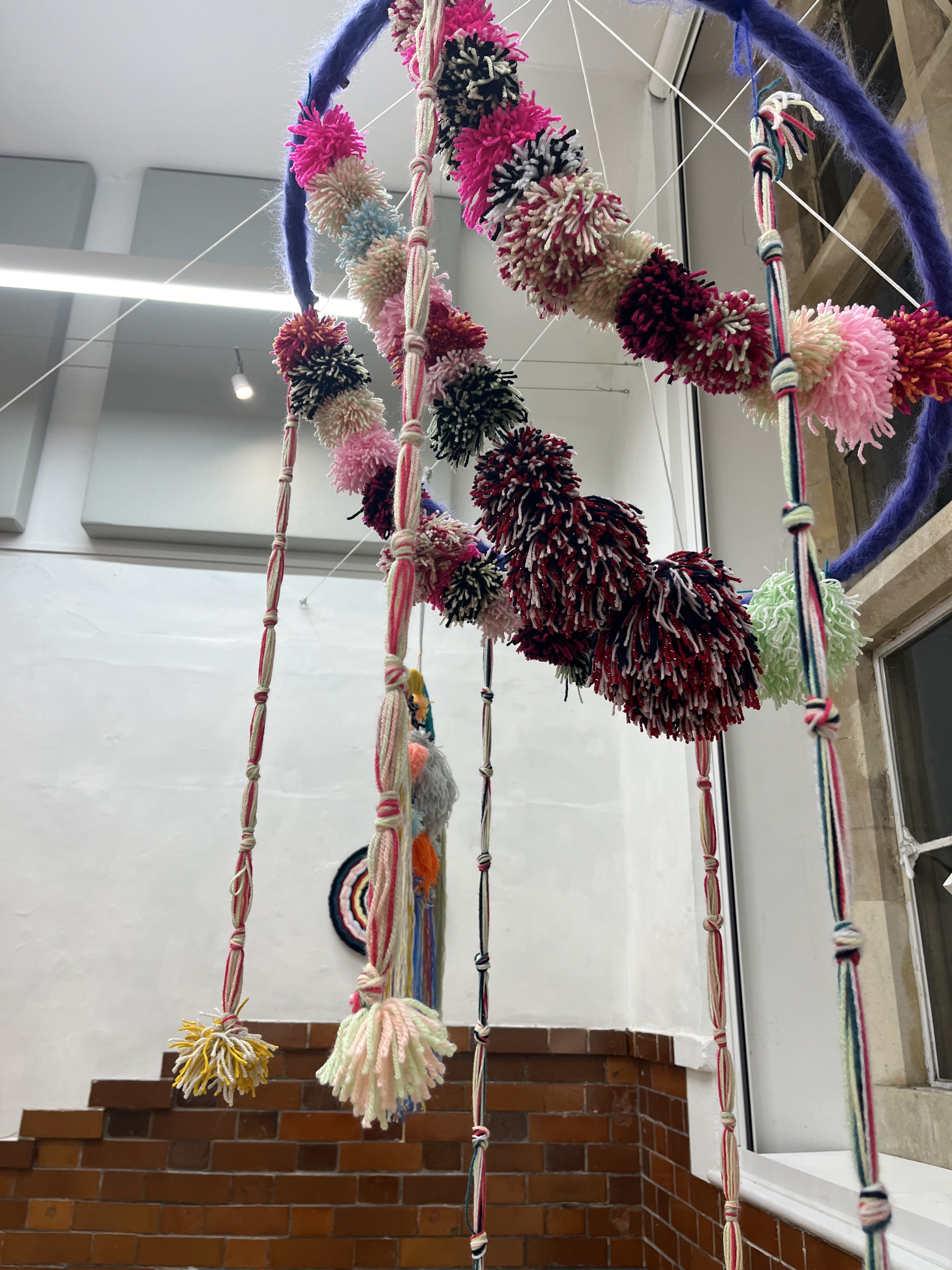
Through AIM, Betty has also begun writing, publishing poetry in The Mermaid’s Hair is Water (2025) with the recently formed Creative Writing Group, delivering crochet workshops for other learning-disabled artist groups and participating in international residencies; “I love travelling. I love going to see new places and trying new things—it’s very inspiring.” Her first residency in El Arreciado, Toledo, Spain — a snippet which Betty shares in two collaged self-portraits Self Portrait Knitting 1 and 2 (2020)— proved transformative, opening new ways of working and thinking that surface in The joy of Pom Poms (2025-2026). These suspended works were developed in situ, their forms unfolding during the installation, shaped by its environment and challenges from peers.
At its heart, Fragments of Joy presented an artist driven by curiosity, discovery and an unwavering devotion to making. Betty speaks of her practice with infectious joy and pleasure: “I just love it, I could make and crochet all day,” a sentiment that radiates through every aspect of her work. That she never imagined ever having a solo exhibition only intensifies her limitless possibilities, leaving us eager to follow where her making leads next.
You can see more of Betty’s work and writing, alongside other artists from AIM at the group exhibition The Everyday, showing at The Pound Arts Centre from 8 May – 6 June 2026.

